
CASE STUDY
Seismic II takes schools to the next level
Large public works, like schools and hospitals, are increasingly benefitting from the faster delivery of modern methods of construction, such as modular building. The catch is that there are many platforms for modular structures that can prove incompatible, leading to potential waste and increased cost.
3 February 2022

CASE STUDY
Smart, sustainable homes for the future
An estimated 345,000 homes need to be built in the UK each year to meet demand. To reach the Government’s target of net zero by 2050, each of them will need to have impeccable green credentials. Achieving this requires examining radical solutions.
3 February 2022

CASE STUDY
End-to-end hydrogen – supporting critical infrastructure
Hydrogen is a powerful fuel source that has the potential to revolutionise a number of sectors, including transport. With almost zero carbon emissions and a high energy density, this abundant gas promises to be a key element of delivering net zero whilst satisfying the increasing national need for energy.
3 February 2022

CASE STUDY
Creating jobs in nuclear energy
Nuclear is an obvious answer, but lead times are lengthy and the financing challenges for large reactors are formidable.
3 February 2022

CASE STUDY
Pressing ahead with rehab revolution
The AMRC has helped a Sheffield SME transform healthcare by making a rehabilitation innovation 11% lighter and cutting the cost of manufacturing for three components by a combined 73%.
3 February 2022

CASE STUDY
Supporting patients with cerebral palsy
The current standing frames have a number of limitations, including high cost of manufacture, ease of use for medical professionals and carers, and the bespoke nature of each frame making it difficult to re-adapt them for other patients.
3 February 2022

CASE STUDY
Immersive tech trains global health heroes from their homes
Immersive technology has been used to help train surgeons who faced reduced learning opportunities due to COVID-19 restrictions.
3 February 2022

CASE STUDY
Anti-microbial poles for public transport could help in future pandemics
Since the beginning of the COVID-19 pandemic many people have been hesitant about taking public transport. In part, this is due to the potential risk of picking up germs from areas travellers must use, such as the grab-poles on trains, buses and trams.
3 February 2022

CASE STUDY
Dental aerosol protection equipment to safeguard against airborne particles
To help address this, the MTC has developed ‘Halo’. Designed to protect dentistry staff and patients against contaminated aerosol particles, it provides up to 99% protection when used in conjunction with standard dental high-volume extraction equipment.
3 February 2022
CASE STUDY
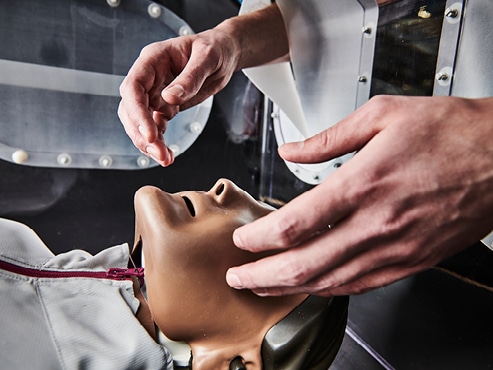
Developing an aerosol-generating procedure shield to protect NHS workers
Identified as an opportunity to reduce the exposure our healthcare workers face when treating patients, the enhancement offers a number of benefits, including a substantial weight reduction from 9kg to 4.5kg, improved visual clarity and ease of use.
3 February 2022

CASE STUDY
The UK’s vaccine programme has been vital in combatting COVID-19. In April 2020, CPI joined the UK Government’s Vaccine Taskforce to support the manufacture and formulation of novel mRNA vaccine candidates in the fight against the virus.
3 February 2022
CASE STUDY
When thought leaders are brought together, incredible things can happen. This is why we partner with the University of Cambridge’s Institute for Manufacturing to convene the single largest group of leading academics, researchers and industry representatives each year.
3 February 2022